
When Copay Assistance Doesn’t Count: Why Patients Need Protection
By Deb Andio | Arthritis Patient Advocate
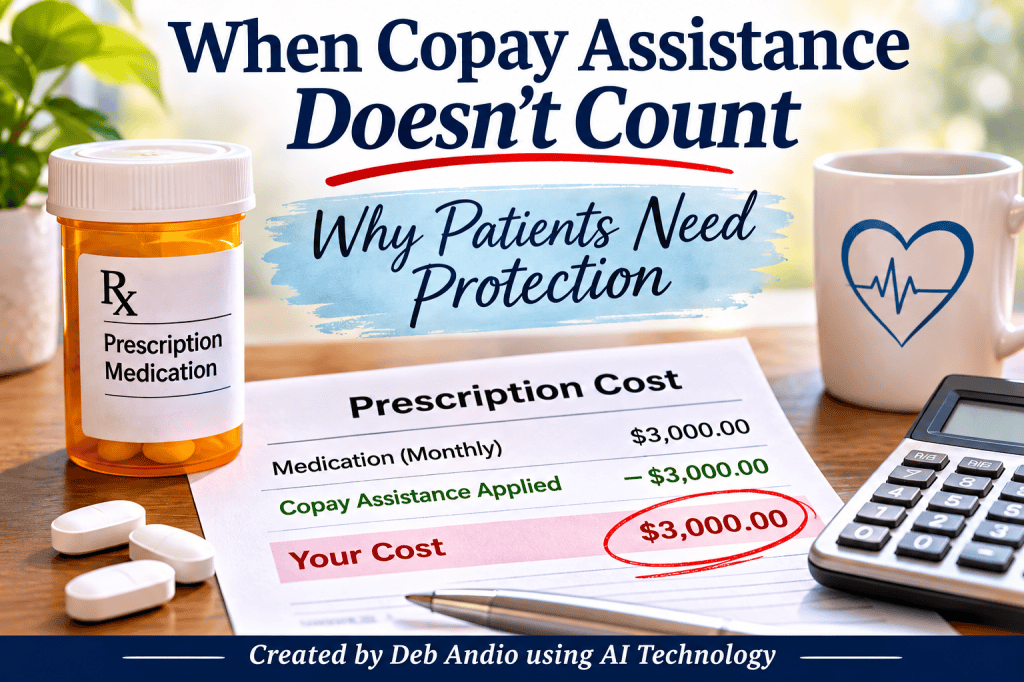
Imagine living with a chronic illness that requires medication costing $3,000 every month. That medication may be the very thing that allows you to get out of bed, go to work, care for your family, and maintain some independence.
Now imagine receiving help from a pharmaceutical manufacturer through a copay assistance program. You are relieved because that assistance makes your medication affordable.
But several months later, you arrive at the pharmacy to refill your prescription and discover that you suddenly owe thousands of dollars.
How could this happen when you have been using your copay assistance card all along?
The answer may be something called a copay accumulator adjustment program.
As an arthritis patient advocate, I believe this is an issue that every patient, caregiver, and family member should understand. It is also an important reason why advocacy matters.
What Is a Copay Accumulator Adjustment Program?
Many people living with chronic illnesses depend on expensive prescription medications to manage their conditions.
For individuals living with rheumatoid arthritis, psoriatic arthritis, juvenile arthritis, and other inflammatory diseases, biologic medications can be essential to controlling inflammation, reducing symptoms, and preventing further joint damage.
Unfortunately, these medications can be extremely expensive.
To help patients afford treatment, some pharmaceutical manufacturers offer copay assistance programs that cover part or all of a patient’s required copayment, subject to eligibility requirements and program limits.
Traditionally, these payments could count toward a patient’s insurance deductible and annual out-of-pocket maximum, depending on the health plan.
However, some insurance plans use copay accumulator adjustment programs.
Under these programs, money provided by a manufacturer to help pay for a prescription may not count toward the patient’s deductible or out-of-pocket maximum.
In other words, the medication is being paid for, but the insurance company may not recognize that assistance as progress toward the patient’s annual cost-sharing obligations.
That distinction can have serious financial consequences.
A Real-World Example: How Patients Can Suddenly Owe Thousands
The Arthritis Foundation provides an example that illustrates how these programs can affect patients.
Imagine the following situation.
January: A new insurance year begins.
You take a biologic medication that costs $3,000 per month. Fortunately, you qualify for a manufacturer copay assistance program that helps cover your prescription costs.
You may pay nothing, $5, or another relatively small amount at the pharmacy.
For the first few months, everything seems manageable.
March: Your assistance is running out.
Your manufacturer assistance program has an annual benefit limit of $9,000.
After approximately three months of prescriptions, that assistance has been exhausted.
You might assume that the $9,000 already paid toward your medication has helped satisfy your deductible or out-of-pocket maximum.
But your insurance plan uses a copay accumulator adjustment program.
The manufacturer payments have not been credited toward those amounts.
April: An unexpected financial burden.
You return to the pharmacy for your next refill.
Instead of the small copayment you have become accustomed to paying, you learn that you may now be responsible for the full $3,000 cost of your medication because your deductible has not been met.
For someone living on a fixed income, supporting a family, or already struggling with medical expenses, that unexpected bill can be devastating.
The exact amount a patient owes depends on their insurance coverage, deductible, medication, and benefit design. Nevertheless, the example demonstrates how quickly a patient can face an unaffordable prescription bill.
And what happens when that patient simply does not have $3,000?
They may leave the pharmacy without the medication they need.
What the Arthritis Foundation’s Patient Survey Revealed
The Arthritis Foundation has collected information about how unexpected prescription costs affect patients.
In a survey involving more than 600 patients, the Foundation reported some troubling findings.
- 84% said a large, unexpected prescription charge would affect their overall household budget.
- 24% reported that when faced with an unexpected charge, they did not fill their prescription.
- 8% reported that they did not take their medication as prescribed.
- 39% of patients with employer-sponsored insurance reported using a manufacturer copay card to help pay for arthritis medications.
These numbers represent real people making difficult decisions about their health and finances.
The presentation also cited employer surveys indicating that accumulator programs were becoming more common. One survey reported that nearly 30% of employers had implemented such a program for 2019, while another reported that 54% of respondents did not credit third-party copay assistance toward patient deductibles.
These are historical survey findings presented in the Arthritis Foundation’s educational material, not current 2026 estimates. However, they help explain why the issue became an important focus of patient advocacy.
When Financial Barriers Become Health Barriers
Living with arthritis can already involve considerable challenges.
There may be chronic pain, fatigue, morning stiffness, limited mobility, and difficulty completing everyday activities.
For some people, medication is essential to slowing disease progression and maintaining their quality of life.
When patients cannot afford prescribed treatment, the consequences can extend far beyond their finances.
They may delay refilling prescriptions, skip doses, stretch medications longer than prescribed, or discontinue treatment without consulting their healthcare providers.
For people with inflammatory arthritis, interruptions in effective treatment can increase the risk of uncontrolled inflammation, disease flares, and potentially irreversible joint damage.
No patient should have to choose between purchasing groceries, paying their mortgage, keeping the electricity on, or obtaining medication that helps protect their health.
Yet financial pressures can force patients into precisely those decisions.
What Is the Arthritis Foundation Advocating For?
The Arthritis Foundation has supported efforts to ensure that financial assistance used to pay for prescription medications counts toward patients’ insurance cost-sharing requirements.
Its position, as explained in the educational presentation, is that when calculating a patient’s deductible or out-of-pocket maximum, health plans should include qualifying amounts paid by patients or on their behalf.
The advocacy message is straightforward:
All copays should count.
Bipartisan legislation has been introduced at both federal and state levels to address copay accumulator practices and protect patients from unexpected medication costs.
The goal is to ensure that patients receive appropriate credit for financial assistance used to obtain their prescribed medications.
The legal landscape is complicated. Protections vary by state, insurance plan, and whether a plan is regulated by state or federal law. Some plan designs and assistance arrangements may be treated differently.
This is why continued legislative advocacy and patient education are so important.
Why This Matters to Me as an Arthritis Advocate
Living with osteoarthritis and other chronic musculoskeletal conditions has taught me how much chronic illness can affect everyday life.
I understand the frustration of pain, physical limitations, medical appointments, and the uncertainty that sometimes accompanies treatment.
Although osteoarthritis is different from the inflammatory forms of arthritis commonly treated with biologic medications, I advocate for the broader arthritis community because patients deserve access to appropriate care, regardless of their diagnosis.
As an Arthritis Foundation advocate and Connect Group facilitator, I have seen how valuable education, encouragement, and shared experiences can be.
Many patients are already doing everything they can to manage their conditions. They should not also have to navigate confusing insurance policies without understanding how those policies may affect their treatment.
I believe advocacy begins with education.
When we understand an issue, we can ask better questions, share accurate information, and help others become informed advocates for themselves.
Not everyone has the energy, physical ability, or financial resources to fight through complicated insurance problems.
That is why our voices matter.
We can speak up for patients who are too exhausted, overwhelmed, or frightened to speak up for themselves.
What Can Patients Do to Protect Themselves?
If you use manufacturer copay assistance for an expensive prescription, there are several important steps you can take.
1. Contact your health insurance company.
Ask whether your plan uses a copay accumulator adjustment program or a copay maximizer program. These programs work differently, but both may affect how manufacturer assistance is applied.
2. Ask whether copay assistance counts toward your deductible.
Do not assume that because your prescription is being paid for, those payments are reducing your deductible or out-of-pocket maximum.
3. Understand your assistance program’s annual limit.
Contact the manufacturer assistance program and ask how much assistance is available, how much has been used, and when the benefit resets.
4. Review your insurance documents.
Look for language involving third-party payments, manufacturer coupons, copay assistance, accumulator programs, and out-of-pocket maximums.
5. Ask about patient protections in your state.
Some states have enacted laws addressing copay accumulator practices. Whether those protections apply depends partly on the type of health plan you have.
6. Speak with your healthcare team before changing medication.
If you cannot afford a prescription, contact your prescribing provider. There may be alternative assistance programs, coverage appeals, or treatment options worth discussing.
7. Become involved in advocacy.
Contact your elected representatives and explain how prescription affordability affects patients and families. Personal stories can help lawmakers understand the consequences of insurance policies.
Advocacy Is About More Than Legislation
When people hear the word advocacy, they sometimes think it means traveling to Washington, attending legislative meetings, or speaking before elected officials.
Those activities are important, but advocacy can also begin with a conversation.
It can mean explaining a complicated insurance term to another patient.
It can mean helping someone prepare questions for their insurance company.
It can mean sharing educational resources, participating in an Arthritis Foundation event, or contacting a legislator from home.
For those of us living with chronic illness, advocacy must also be accessible and flexible. We have days when pain, fatigue, family responsibilities, and medical appointments limit what we can do.
Every meaningful contribution matters.
Our Voices Can Make a Difference
I believe patients deserve transparency, fairness, and affordable access to medically necessary treatment.
Copay assistance is intended to help people obtain medications they might otherwise struggle to afford.
When insurance arrangements prevent that assistance from counting toward a patient’s financial obligations, the result can be confusion, unexpected bills, and interruptions in treatment.
That is why I support continued education and advocacy surrounding copay accumulator adjustment programs.
I encourage you to learn more, ask questions about your own insurance coverage, and share this information with others.
You never know who may be struggling silently with the cost of their medication.
Sometimes, simply helping someone understand their options can make a meaningful difference.
Because patients should be focused on managing their health, not wondering whether they can afford their next prescription.
And that is one more reason I advocate.
Learn More and Get Involved
Arthritis Foundation Advocacy: https://www.arthritis.org/advocacy
Arthritis Foundation educational video: Policy 101: Accumulator Adjustment Programs
Advocacy campaign: #AllCopaysCount
Educational disclaimer: This article is intended to raise awareness and provide general information about prescription affordability and insurance practices. It is not medical, legal, or insurance advice. Patients should consult their healthcare providers, insurance administrators, and appropriate assistance programs regarding their individual circumstances.
Survey statistics and the illustrative prescription example are drawn from the Arthritis Foundation’s educational presentation. They should not be interpreted as current national prevalence estimates or as a description of every insurance plan.
Federal| a bill was recently introduced that will help. Patient afford their medication’s by ensuring that any co-pay assistance counts towards their out-of-pocket deductible to help ensure lower patient (HELP) co-pays act (S.864) is a two part solution that curbs a growing practice called accumulator adjustment programs that prevent co-pay assistance such as a co-pay card through a manufacturer from counting towards your overall out-of-pocket cost meaning once your co-pay assistance runs out you must pay your full deductible, an annual out-of-pocket requirement to access your medication
Do you know if your healthcare plan has a co-pay accumulator take a few moments to check review your health plan review the language in your health plans documents these programs may be called
coupon adjustment
benefit plan protection programs
out-of-pocket protection program
or co-pay leveling programs
For more information check out,
arthritis.org/advocate/action-center


Leave a Reply