
When most of us think about the holidays, we think about family.
Thanksgiving dinner. Christmas morning. New Year’s Eve. Summer cookouts. Long weekends surrounded by the people we love.
But for someone living with domestic violence, a holiday can mean something entirely different.
It can mean more hours trapped in the house with an abuser.
More drinking.
More financial stress.
More arguments.
More jealousy.
More opportunities for control.
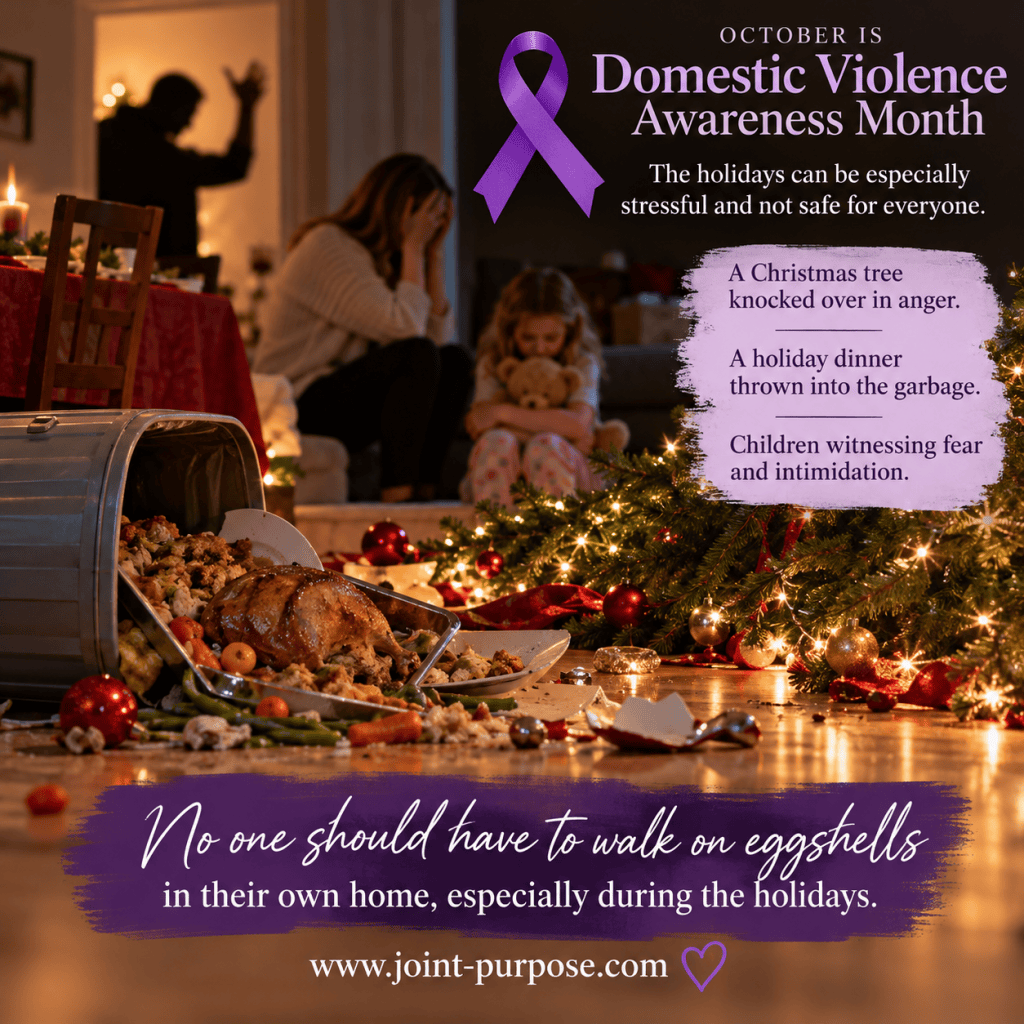
More walking on eggshells, trying desperately not to say or do the one thing that might set someone off.
And sometimes, more violence.
That is why, as we talk about Domestic Violence Awareness Month, we also need to talk about what happens when the holidays arrive.
Some Holidays Are Associated With Higher Domestic-Violence Injuries
A large U.S. study examining emergency-department data from 2005 through 2017 found significantly higher rates of intimate-partner-violence injuries around several major holidays, including New Year’s Eve, St. Patrick’s Day, the Fourth of July, Labor Day, Thanksgiving, and Christmas. New Year’s Eve showed the largest increase among the holidays researchers examined.
Think about that list.
These are days we associate with celebration.
For another person, they may be days of fear.
New Year’s Eve
While people are counting down to midnight and celebrating a new beginning, someone may be praying simply to make it safely through the night.
New Year’s Eve stood out in the national emergency-department research as a particularly high-risk holiday period for intimate-partner-violence injuries.
Alcohol may be present. Emotions may be heightened. Couples may be together for extended periods.
But I want to make something absolutely clear:
Alcohol does not cause someone to become an abuser.
Neither does stress.
Neither does losing money.
Neither does an argument.
Neither does jealousy.
Those things may be present when violence occurs, but the person who chooses violence is responsible for the violence.
Thanksgiving
Thanksgiving is supposed to be about gratitude, family, and gathering around a table together.
But the same research found intimate-partner-violence injuries significantly elevated during the Thanksgiving holiday period.
While one family is passing the turkey, another woman may be sitting at that table trying to hide what happened the night before.
She may have makeup covering a bruise.
She may be wearing long sleeves.
She may barely speak because she knows she’ll pay for it when everyone leaves if she says the wrong thing.
And everyone around the table may believe everything is fine.
Sometimes the woman who needs help the most is the one working the hardest to convince everyone that she doesn’t.
Christmas
Christmas can be especially complicated for someone living with abuse.
There may be financial pressure, family expectations, children in the home, travel, alcohol, arguments over money, and extended periods of time together.
The National Domestic Violence Hotline specifically provides holiday safety-planning guidance because holidays and long weekends can present additional challenges for people experiencing abuse.
Imagine being a mother trying to create a beautiful Christmas morning for your children while privately wondering what kind of mood their father will be in when he wakes up.
Imagine trying to keep the children quiet.
Trying to keep everyone happy.
Trying to prevent an argument.
Trying to protect your children from seeing what you’ve already seen too many times.
For some families, Christmas isn’t peaceful. It’s survival.
And that is why our domestic-violence shelters need us during the holidays.
The Fourth of July, Labor Day and St. Patrick’s Day
The same national research found significantly elevated intimate-partner-violence and other assault-related injuries around St. Patrick’s Day, Independence Day, and Labor Day as well.
These are often social holidays—parties, cookouts, drinking, gatherings and long weekends.
Again, none of those things causes abuse.
Millions of people drink alcohol, experience financial stress, lose their temper, disagree with their partner, or have a terrible day without assaulting another human being.
Abuse is a choice made by the abuser.
We cannot allow alcohol, stress, sports, money, or holidays to become excuses.
And What About the Super Bowl?
We have all heard the claim that Super Bowl Sunday is one of the worst days of the year for domestic violence.
It has been repeated so many times that many people assume it is established fact.
But I don’t want to use questionable statistics simply because they make a powerful headline.
A peer-reviewed U.S. study examining emergency-department data found no significant increase in overall assaults or intimate-partner violence associated with Super Bowl Sunday or Super Bowl weekend. Researchers also examined whether losses, including upset losses, were associated with increases and did not find evidence supporting the popular claim.
That doesn’t mean domestic violence doesn’t happen on Super Bowl Sunday.
Of course it does.
It means we should not repeat a statistic that research doesn’t support.
Domestic violence is horrific enough without exaggerating the numbers.
Weekends Matter Too
The concern isn’t limited to holidays.
Research examining more than 21 million assault-related emergency-department visits found strong weekend patterns in assault injuries, including weekend peaks in intimate-partner violence.
For somebody living with an abusive partner, Friday evening may not mean:
“Finally, the weekend.”
It may mean:
“He’s going to be home.”
Think about how different those words sound when you’re afraid of the person you live with.
Churches: Please Pay Attention During the Holidays
This is another reason I want churches involved.
Churches are extraordinarily active during Thanksgiving and Christmas.
We collect food.
We buy presents for children.
We adopt families.
We organize Christmas programs.
We fill baskets.
Those are beautiful things.
But while we’re doing those things, remember the domestic-violence shelter in your community.
Call them and ask what they actually need.
Maybe it’s toiletries.
Maybe it’s children’s clothing.
Maybe it’s gift cards.
Maybe it’s diapers.
Maybe it’s transportation assistance.
Maybe it’s money.
Maybe it’s Christmas presents for children who had to leave everything behind.
Maybe it’s help giving a mother a Christmas morning when she thought her children weren’t going to have one.
And churches need to make sure women know that if they are being abused, they can come forward without being judged or shamed.
Schools: Watch the Children
Teachers, counselors, coaches and school staff may see something the rest of us don’t.
A child suddenly becomes withdrawn.
A child is exhausted.
A child’s behavior changes.
A child becomes frightened when it’s time to go home.
A teenager suddenly has to care for younger siblings.
A normally social child becomes anxious or angry.
Those signs can have many causes and should never automatically be assumed to mean domestic violence.
But they can mean that a child needs somebody to pay attention.
Because children don’t leave domestic violence at the front door when they walk into school.
They carry home with them.
Employers: The Holidays May Be When She Needs You Most
The woman who suddenly needs time off may not be irresponsible.
She may be trying to get a protective order.
She may be talking to an attorney.
She may be moving.
She may be trying to get her children somewhere safe.
She may have spent the night in an emergency room.
She may have been awake all night because someone was threatening her.
She may be trying to leave while keeping her job because that paycheck is the only thing standing between her and having to return.
Employers cannot solve domestic violence.
But compassion, appropriate workplace policies, security planning and access to resources can make an enormous difference.
Family and Friends: Don’t Ruin Her Opportunity to Leave
If somebody confides in you that she is being abused, take her seriously.
Don’t confront the abuser yourself.
Don’t announce that she’s planning to leave.
Don’t post anything on social media.
Don’t tell mutual friends information she gave you privately.
Don’t decide for her what she should do next.
Leaving an abusive relationship can be dangerous, and safety planning should involve trained domestic-violence professionals whenever possible.
Instead, tell her:
“I believe you.”
“You don’t deserve this.”
“I’m not going to judge you.”
“Let’s find someone who can help you make a safe plan.”
That is support.
Stop Saying, “Why Doesn’t She Just Leave?”
Especially during the holidays.
Maybe she doesn’t have any money.
Maybe she has children.
Maybe the shelters are full.
Maybe she has nowhere to go.
Maybe he’s threatened to kill her.
Maybe he’s threatened her family.
Maybe she’s afraid he’ll take the children.
Maybe he’s monitoring her phone.
Maybe he’s controlling the bank account.
Maybe she’s already left before and he stalked her until she returned.
Maybe she’s terrified.
Maybe she still loves him.
Maybe she’s been told for so long that she’s worthless that part of her believes she cannot survive without him.
You don’t know.
So stop standing outside someone else’s nightmare asking why she hasn’t escaped it quickly enough.
Help her find the door.
This Holiday Season, Remember the Family Who Had to Run
When you’re shopping for Thanksgiving dinner, remember them.
When you’re buying Christmas presents, remember them.
When you’re making your holiday charitable donations, remember them.
When your church chooses its Christmas outreach projects, remember them.
When your company organizes its holiday giving campaign, remember them.
Remember the mother who left with one bag.
Remember the children who left their toys behind.
Remember the woman who doesn’t have Christmas decorations because she’s starting over in a shelter.
Remember the family that may be celebrating Christmas in one small room—but for the first time in years, nobody is afraid.
Donate to your local domestic-violence shelter.
Ask what they need rather than assuming.
Support organizations that help survivors with housing, legal advocacy, transportation, counseling and safety planning.
And if someone you know tells you she is being abused, don’t stand there and judge her for staying.
Stand beside her while she finds a safe way out.
Because for some women, the greatest gift they will receive this holiday season will not be underneath a Christmas tree.
It will be freedom.
It will be safety.
It will be waking up and realizing that, for the first time in a very long time, they don’t have to be afraid.


Leave a Reply