
Artificial intelligence is not coming.
It is already here. In many areas it’s been here in company robotics.
It is entering our schools, businesses, workplaces, phones, cars, healthcare systems, financial institutions, entertainment, and homes.
Over the coming years, knowing how to work with AI may become as fundamental as knowing how to use the internet, send an email, or search for information online.
That is why learning AI is critical.
But there is another lesson that needs to be taught at exactly the same time:
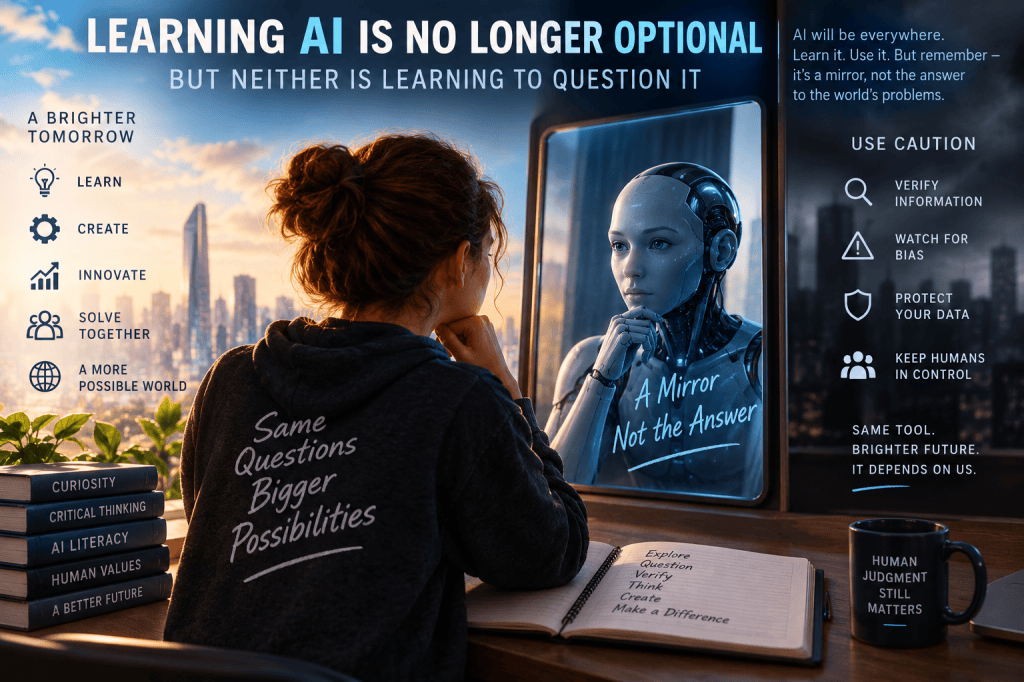
AI is a mirror. It is not the answer to all of the world’s problems.
Learning how to use artificial intelligence without learning when to question it could be more dangerous than not understanding AI at all.
We Need to Learn AI Because It Will Be Everywhere
There was a time when people could reasonably say they didn’t need to understand computers.
Then computers became part of almost every profession.
The same thing happened with the internet.
Today, we may be watching another transformation.
AI is becoming part of how people research, communicate, design, program, analyze information, teach, learn, create, and make decisions.
The question will increasingly become less about whether you use AI and more about how well you use it.
People should understand what AI can do.
They should learn how to ask good questions, evaluate responses, use AI to explore ideas, automate repetitive work, analyze information, and increase their productivity.
But they also need to understand something equally important:
What AI cannot do.
AI Literacy Must Include Skepticism
Learning AI should not simply mean learning how to write the perfect prompt.
True AI literacy means understanding the technology well enough to know when not to trust it.
AI can be incredibly impressive.
It can analyze thousands of words in seconds.
It can explain complicated subjects.
It can generate software.
It can help create images, videos, presentations, and documents.
It can identify patterns that would take a human much longer to find.
But impressive does not mean infallible.
AI can misunderstand context.
It can reproduce misinformation.
It can make incorrect assumptions.
It can provide outdated information.
And sometimes it can simply be wrong.
The more powerful AI becomes, the more important human judgment becomes alongside it.
AI Is a Mirror
This may be one of the most important ideas to understand about artificial intelligence:
AI reflects us.
AI systems learn from enormous amounts of human-created information.
That means they encounter our greatest achievements.
Our science.
Our literature.
Our discoveries.
Our creativity.
Our history.
Our ideas.
But they can also encounter our mistakes, prejudices, arguments, misinformation, exaggerations, and misconceptions.
We should not expect technology trained on humanity’s information to somehow emerge completely separated from humanity’s imperfections.
AI can amplify the best of what we have created.
But without care, it can also amplify the worst.
That is why calling AI a mirror matters.
Sometimes what we see reflected back at us is brilliant.
Sometimes it is wrong.
And sometimes it tells us more about ourselves than it does about the truth.
AI Is a Tool, Not a Solution to Humanity
Every major technology arrives with enormous promises.
AI is no different.
We hear that AI could transform healthcare, accelerate scientific discoveries, improve education, increase productivity, help address climate challenges, and solve problems previously considered impossible.
Some of those possibilities are genuinely exciting.
But technology alone does not solve human problems.
AI cannot manufacture wisdom.
It cannot guarantee fairness.
It cannot decide what kind of society we should build.
It cannot determine our values for us.
Those remain human responsibilities.
We should be especially cautious when we start believing that because a machine can calculate something faster than we can, it should therefore make the decision for us.
Intelligence and wisdom are not the same thing.
The Biggest Risk May Be Giving Up Our Own Thinking
There is another danger that receives less attention.
AI can make things so easy that we stop doing the difficult work ourselves.
Why struggle with a problem when AI can provide an answer?
Why write the first draft?
Why research the subject?
Why wrestle with competing ideas?
Why learn something when we can simply ask?
Because sometimes the struggle is the learning.
Critical thinking develops when we question information, compare ideas, make mistakes, reconsider our assumptions, and work toward understanding.
If AI always gives us the first answer, we have to be careful that it does not become our only answer.
The goal should be to use AI to expand human thinking, not replace it.
Children Especially Need AI Literacy
This makes education incredibly important.
Young people are growing up in a world where AI may always be available.
Teaching them simply how to operate AI will not be enough.
We need to teach them how to question it.
Ask:
Where did this information come from?
Can I verify it?
Is another perspective missing?
Is this fact or opinion?
Could the question I asked have influenced the answer?
Does this actually make sense?
Perhaps most importantly:
What do I think?
Those questions may become some of the most important educational tools of the AI generation.
Use AI : But Keep Humans in the Driver’s Seat
We should not fear artificial intelligence.
And we should not worship it.
We should learn it.
Understand its capabilities.
Understand its limitations.
Experiment with it.
Build with it.
Teach our children how to use it.
Teach our employees how to work with it.
Use it to make discoveries, increase productivity, spark creativity, and tackle difficult problems.
But maintain a healthy level of caution.
Verify important information.
Question extraordinary claims.
Protect sensitive information.
Understand who is responsible for important decisions.
And never confuse a confident answer with an unquestionable truth.
The Future Requires Two Skills
The AI era will require us to develop two abilities at the same time.
The first is knowing how to use artificial intelligence.
The second is knowing when not to trust it.
We cannot afford to learn one without the other.
AI will become more capable.
It will become more convincing.
It will become more integrated into everyday life.
And that makes human judgment more important, not less.
Learn AI.
Use AI.
Build with AI.
Explore what it can make possible.
But never hand over your curiosity, judgment, values, or responsibility to it.
AI can be an extraordinary mirror of human knowledge and creativity.
But a mirror can only reflect what we put in front of it.
The responsibility for deciding where we go next still belongs to us.


You must be logged in to post a comment.